USELESS INTRODUCTION
Here you can find out a bit
too much about me.
If you feel like it.

I’ve always loved writing. My mother taught me to read and write long before I started school, and I immediately began filling pages with poems, stories and rather questionable attempts at novels.
As a teenager I filled an unreasonable number of pages: I absorbed life, people and colours and tried to put them on paper before they changed.
Then, in 1979, a nun walked into my classroom in Rapallo and asked who wanted to do theatre. She hadn’t even finished the question and my hand was already in the air.
That was how I met Mario Forella, my first teacher: grumpy, uncompromising and with a huge heart. I stayed with him for ten years. From there began a journey that would take me into acting, directing, teaching, Cinecittà, theatre companies and more than eighty productions.


Writing, however, never went away.
Neither did Iron Maiden.
Calling them simply my favourite band would be something of an understatement. They came into my life when I was young and since then they have become concerts, journeys, friendships, history, London, album covers, characters and an entire world that has followed me through a large part of my life.
I’ve always been fascinated by the world built around the music too: Eddie, of course, but also history, literature, cinema and all those different settings. Theatre probably has something to do with it. When you spend your life building worlds on stage, you tend to recognise people who know how to do something similar.

In 2013 I moved to the United Kingdom with my family.
Carrying on with theatre here was complicated: I’m not a native speaker and, let’s face it, my English is hardly Royal Shakespeare Company material. I speak it fairly badly, with a Genoese accent that doesn’t exactly help me blend in.
So I went back to writing more seriously. I took courses and workshops, and one piece of advice kept coming up:
“Write what you know.”
Good advice.
I knew theatre. I knew thrillers, which I had always loved reading. By then I was living in England.
And I knew Iron Maiden. Rather well.
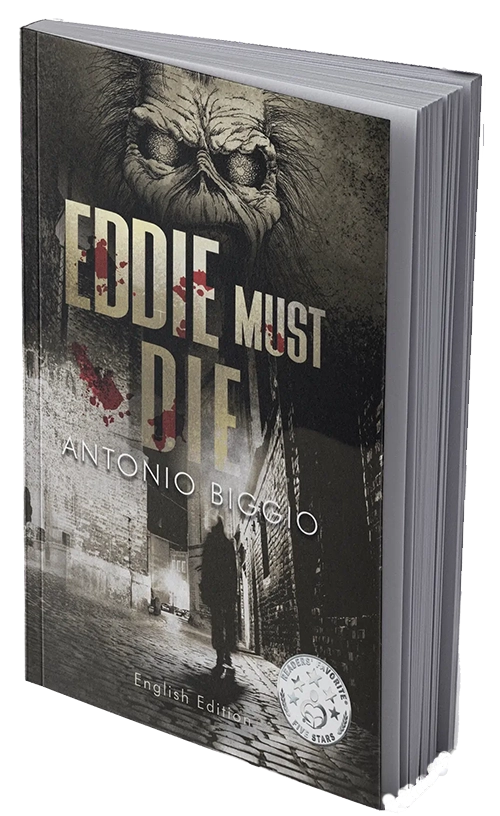
That was where Eddie Must Die began.
I didn’t want to write a book about Iron Maiden, nor a collection of winks and references for fans. I wanted a proper thriller: London, 1982, an investigation, a conspiracy and a detective who was a very long way from the perfect hero.
The music had to belong to that world just as naturally as the pubs, the streets, the newspapers and the way people spoke and lived.
It was probably inevitable. After a life spent building stories on stage and decades listening to a band that has always made storytelling such an important part of its identity, sooner or later the two had to meet.
Outside books there’s also football, which I’ve followed all my life, and cooking, which I approach with considerably more enthusiasm than skill at presentation. We’ll leave it there before this page becomes genuinely too long.
In the end, theatre and fiction are not all that different. I used to build characters for someone else to bring to life on stage. Now I hand them directly to the reader’s imagination.
The stage has changed. The urge to tell stories hasn’t.
This isn’t my biography. There’s another page for that, properly organised, chronological and considerably more respectable. This is only an introduction.
Useless, apparently.
A proper biography